Starting seeds
Sow a tray, watch it come up, harden it off and move it into a bed — and keep the record when it becomes plants.
Updated October 8, 2026
Starting seeds is the half of the season that happens on a shelf: a tray sown in late winter, seedlings under a light, then a bed. Grow Food Together records that as a sowing, and when the seedlings go into the ground it becomes plants, carrying its history with it.
What a sowing is
A sowing is one batch of seed in one container, sown on one day — a tray of Brandywine tomatoes, a pot of basil, a strip of celery. It has a crop, a shelf, a sow date, how many seeds went in, and what happened next.
A sowing is not a plant: it lives on your nursery shelf until it is planted out, and its counts can change along the way.
If you sow straight into a bed — carrots, peas, radishes — that is a plant, added the way you add any plant, with From seed as its stage. Sowings are for seed started somewhere else first.
Where sowings live
Sowings belong to a nursery area: a seed shelf, a greenhouse bench, a windowsill, a cold frame. Add one under Areas with the kind set to nursery, and the seed-starting page and the shelf’s own page show what is on it.
Because the shelf is an area, watering, feeding and photographing it are ordinary activities logged against the area, and every sowing on the shelf that day shows them in its history.
The sowing calendar
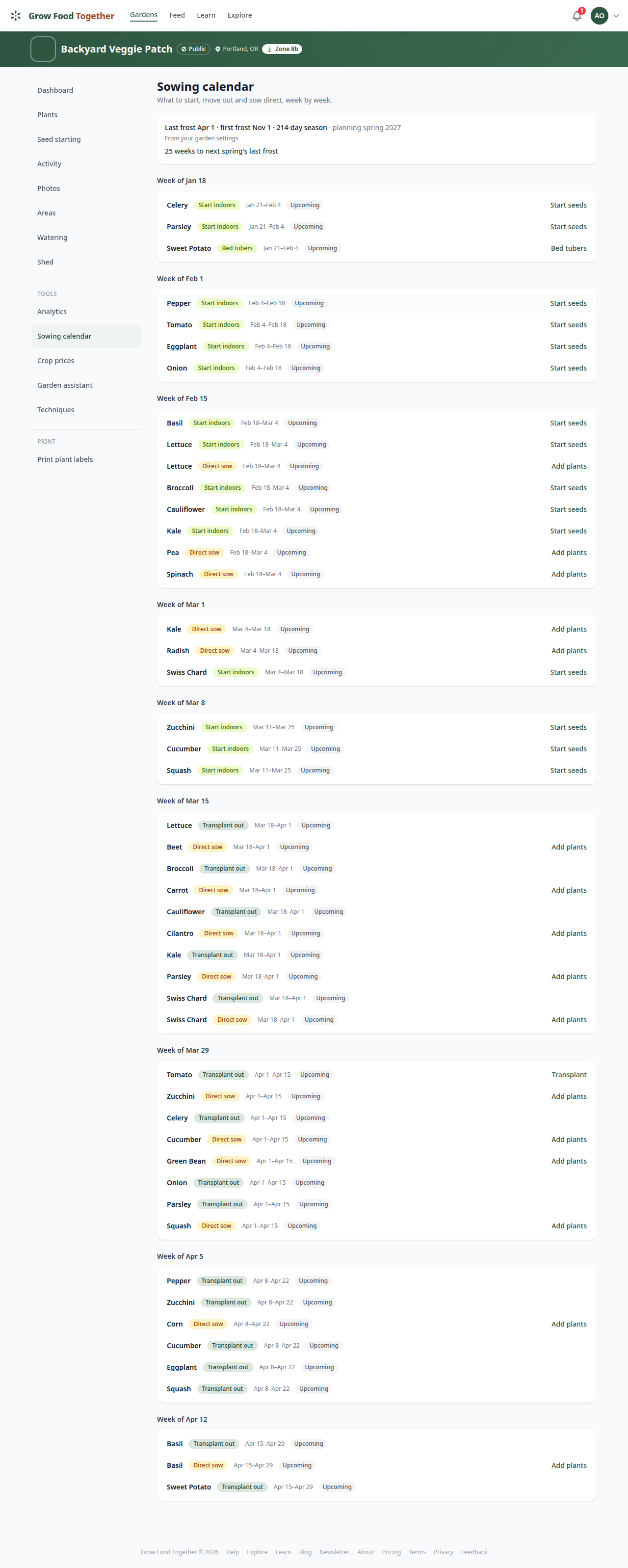
The sowing calendar is the season laid out week by week: when to start each crop indoors, when to move seedlings out, and when to sow straight into a bed. Find it under a garden’s Tools.
It plans from your frost dates. If you have not set them, it uses a typical pair for your hardiness zone and labels every date as an estimate until you enter your own, from the link at the top of the calendar or under garden settings.
Each crop gets a window for each thing there is to do — start indoors, move out, sow direct — each open for a short stretch. A window is done when the record exists — a sowing of that crop near the window, a plant added from seed, or a transplant — so sowing a few days early still counts. A window that closed with nothing recorded is missed, which is information, not a scolding. The crops you already grow come first; the rest of the catalog waits under a fold.
The same signals reach you without opening the calendar: your garden’s dashboard, the written briefing and the weekly digest all show crops to start this week, trays past the time they should have come up, trays part-way through hardening off, and trays ready for a bed. The digest only does so in a week when a window opens for a crop you grow or a tray reached a milestone. Once a day, the bell carries a reminder for the trays and crops that need something that day — one note per garden, however many trays. Turn it off under notification settings; whether it is also emailed follows your instant email setting.
Starting a tray
From Seed starting in a garden, or from a nursery’s page, choose Start seeds. Pick the crop and, if you know it, the variety. Say which shelf it is on, the day you sowed, how many seeds, and how many cells of the tray they took. A tray label like “A” or “left rack” is optional, there so two trays of the same crop can be told apart.
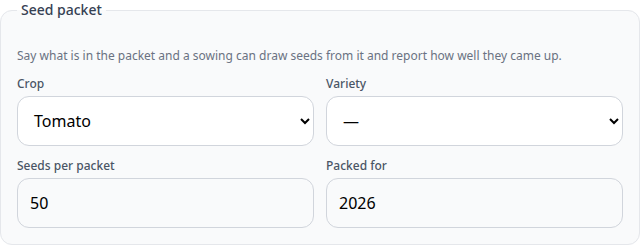
If the seed came from a packet in the shed, pick it. Grow Food Together draws the seed down through the same ledger it uses for fertilizer, so the shed shows what is left and the cost lands in your spend under seeds — by the seeds sown, or by the fraction of a packet that says how many it holds. If neither is known, the packet is noted as used and nothing deducted. Photos of a tray work like photos of a plant.
Milestones
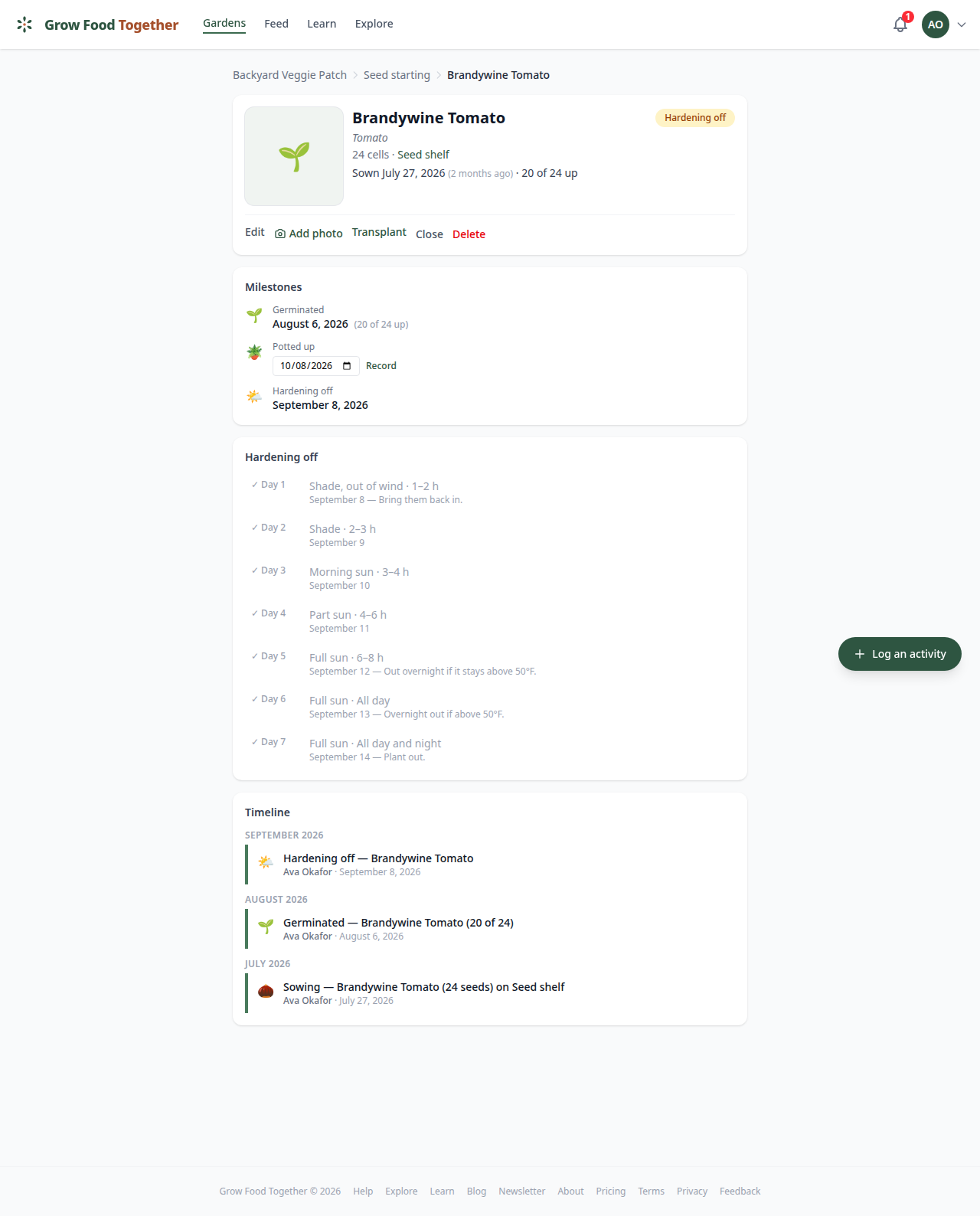
A sowing moves through stages you record as they happen: germinated (with how many came up), potted up (optional — not every crop needs it), and hardening off (the stretch the seedlings spend getting used to outdoors). Each one is a button on the sowing’s page, and each writes an entry in the garden feed and on the sowing’s history. Once hardening off starts, the tray’s page lists it as a run of days, each a little longer outside, with today marked, and tells you when the tray is ready for a bed.
Dates can be corrected: changing a milestone date moves its feed entry, and clearing it removes the entry. Changing the seeds sown does not change what was drawn from the packet. Potting up and hardening off can be recorded in either order; nothing can precede the sow date.
Crops grown from slips
A slip is a rooted sprout, not a seed. A sweet potato tuber is bedded in damp soil until it sprouts; the sprouts are pulled, rooted in water and planted out. Grow Food Together records that as a sowing, and the catalog knows which crops work this way: pick the crop and the words follow.
The first count is Tubers bedded, the button says Bed tubers, and there is no packet — a tuber’s cost is a shed purchase if you want it counted. Slips pulled stands where germinated does, with a count that may exceed the tubers, and In water where potted up does. Nothing is on the shelf until slips are pulled, so Transplant appears once that count is recorded. The calendar says Bed tubers where it would say start indoors.
Transplanting
When the seedlings are ready, choose Transplant on the sowing. Pick the bed, say how many are going out and when. Grow Food Together creates that many plants in the bed, each marked as a seedling and each remembering the tray it came from and the day it was sown.
You can transplant a tray in parts. The sowing stays open until nothing is left on the shelf, then closes on its own. If a tray never made it, close it yourself with Close. Reopen puts a tray back on the shelf, which is also how to transplant from one that closed itself.
The feed entry for a transplant is the plants’ planting record, phrased as a transplant, and belongs to the plants: deleting them removes it. Deleting a plant from a tray also puts one seedling back on the shelf’s count.
What the plants keep
A plant that came from a tray shows Started from seed on its page, with the sow date and a link back to the tray, and the tray’s milestones and photos appear in the plant’s history. Its expected harvest date knows the sow date too: a crop timed from sowing counts from the day you sowed it, not the day it went in the ground.
The plant’s Source card shows its share of the packet’s cost as a note, not a second charge: the shed counted the seed once, at sowing.
Rough edges
The calendar plans spring sowings only; fall planting is not timed yet. The zone estimate is a northern-hemisphere rule of thumb, so gardeners south of the equator should enter their own frost dates. A tray is recorded as counts, not a map of which cell holds what, so two crops in one tray are two sowings.
Didn't find what you needed?
Sign in to send us a note, or read about Grow Food Together and what it costs.